
Reverse Osmosis
How to Calculate the Exact Flow Rate Needed | Industrial Reverse Osmosis
Jul
Choosing the correct reverse osmosis (RO) flow rate is one of the most important decisions when specifying a water treatment system.
Many businesses assume that “bigger is better.” Others purchase the cheapest system available without properly calculating demand.
Both approaches can lead to expensive mistakes.
An undersized system may struggle to keep up with production, while an oversized system often costs more to purchase, consumes unnecessary energy and may not operate as efficiently as intended.
In this guide, we’ll explain exactly how to calculate the correct RO flow rate and the factors engineers consider before recommending a system.
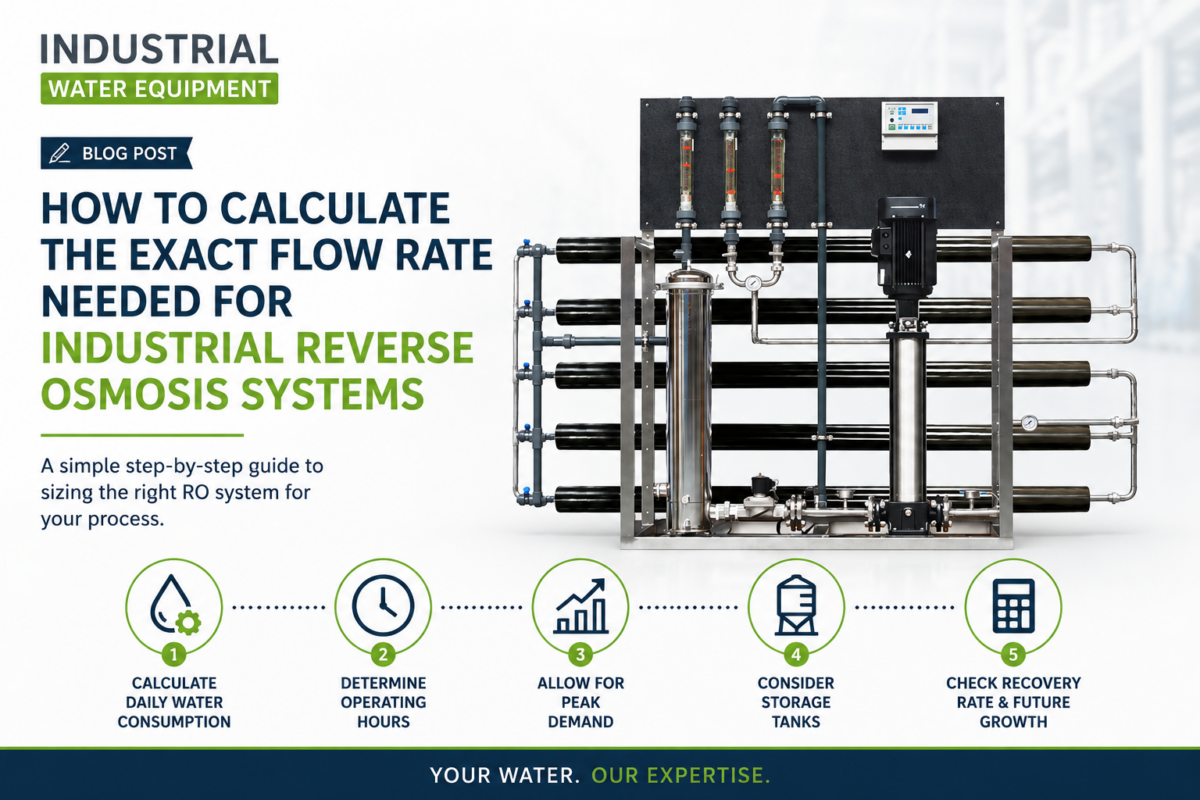
Step 1 – Calculate Your Daily Water Consumption
The first question is simple:
How much purified water do you actually use each day?
For example:
- Production process = 4,500 litres
- Washdown = 800 litres
- Laboratory = 300 litres
- Humidification = 400 litres
Total daily demand = 6,000 litres
This gives you your baseline requirement.
Step 2 – Determine How Many Hours the RO Will Run
An RO system rarely operates 24 hours per day.
Consider your production schedule.
For example:
| Operating Schedule | Hours Available |
|---|---|
| Single shift | 8 hours |
| Double shift | 16 hours |
| Continuous production | 24 hours |
Example:
6,000 litres ÷ 8 hours
= 750 litres/hour
That means you need a system capable of producing at least 750 LPH.
Step 3 – Allow for Peak Demand
Water usage is rarely constant.
Production often increases during:
- Shift changes
- Batch production
- Cleaning cycles
- Tank filling
- Seasonal demand
Most industrial systems are therefore designed with additional capacity.
A typical allowance is around 15–30%, depending on the application.
For the previous example:
750 LPH
+ 20%
= 900 LPH
Now your ideal RO size becomes approximately 900 LPH.
Step 4 – Consider Storage Tanks
Many customers don’t actually require the RO to produce water at the same rate it is consumed.
Instead, purified water is stored in a break tank before being pumped to production.
This means:
A 500 LPH RO may comfortably support processes that occasionally consume 1,500 LPH, provided the storage tank is correctly sized.
Storage often reduces capital cost while improving efficiency.
Step 5 – Consider Recovery Rate
An RO system doesn’t convert every litre of feed water into purified water.
Typical industrial recovery rates range between 50% and 75%, depending on feed water quality and system design.
For example:
Required purified water:
900 LPH
Recovery:
75%
Feed water required:
900 ÷ 0.75 = 1,200 LPH
This has implications for:
- Incoming water supply
- Drainage capacity
- Running costs
- Water usage
Higher recovery isn’t always better. Pushing recovery too high can increase the risk of scaling and reduce membrane life.
Step 6 – Think About Future Expansion
One of the biggest mistakes we see is specifying an RO system purely for today’s production.
Many businesses increase production within a few years, leaving their RO system undersized.
Ask yourself:
- Will production increase?
- Are additional production lines planned?
- Will staffing increase?
- Could another shift be introduced?
If expansion is likely, it can often be more economical to install a slightly larger system now than replace it later.
Common Sizing Mistakes
Choosing Based on Budget Alone
A cheaper system that can’t meet production demand often becomes more expensive in the long run.
Ignoring Peak Usage
Average daily demand rarely tells the full story.
Peak production periods should always be considered.
Forgetting Future Growth
Installing an RO system with no spare capacity often leads to expensive upgrades later.
Over-Specifying the System
Bigger isn’t always better.
Oversized systems:
- Cost more to buy
- Can operate less efficiently
- May experience unnecessary start-stop cycling
- Increase maintenance costs
Correct sizing is about matching production requirements—not simply choosing the largest machine available.
Which IWE RO System Is Right for You?
As a general guide:
| Daily Requirement | Typical IWE Solution |
|---|---|
| Small laboratories & washdown | Compact Range |
| Mobile or temporary applications | Compact IBC |
| 300–1,500 LPH | Pro Range |
| 2,000–3,500 LPH | Promax 4 |
| 4,300–12,000 LPH | Promax 8 |
| Continuous production | Duplex Systems |
| Ultra-high purity | Twin Pass Systems |
Every application is different, so this should only be used as a starting point.
Why IWE Doesn’t Size Systems by Flow Rate Alone
Flow rate is only one part of the design process.
Before recommending a system, we also consider:
- Feed water quality
- Conductivity requirements
- Recovery targets
- Operating pressure
- Water temperature
- Available incoming pressure
- Storage capacity
- Future expansion
- Site footprint
- Energy efficiency
- Maintenance access
- Process criticality
By considering the complete application, we help customers avoid costly oversizing, undersizing and unnecessary operating costs.
Let IWE Help You Size Your Next RO System
Whether you require 150 litres per hour or 12,000+ litres per hour, choosing the correct system starts with understanding your process.
At Industrial Water Equipment Ltd, we design and manufacture industrial reverse osmosis systems tailored to each customer’s exact requirements.
Our experienced engineers will calculate the correct flow rate, recommend the most suitable system and ensure your RO solution delivers reliable, efficient performance for years to come.
