
Reverse Osmosis
Recovery vs Rejection in Reverse Osmosis: What’s the Difference?
Jul
Reverse osmosis (RO) is one of the most effective methods of producing high-quality purified water for industrial applications. Whether you’re supplying boilers, manufacturing processes, laboratories or food production, understanding two key performance indicators—Recovery and Rejection—is essential for getting the most from your RO system.
Although these terms are often mentioned together, they measure two completely different aspects of system performance. Achieving the right balance between them is the key to producing reliable, cost-effective purified water.
What is Recovery?
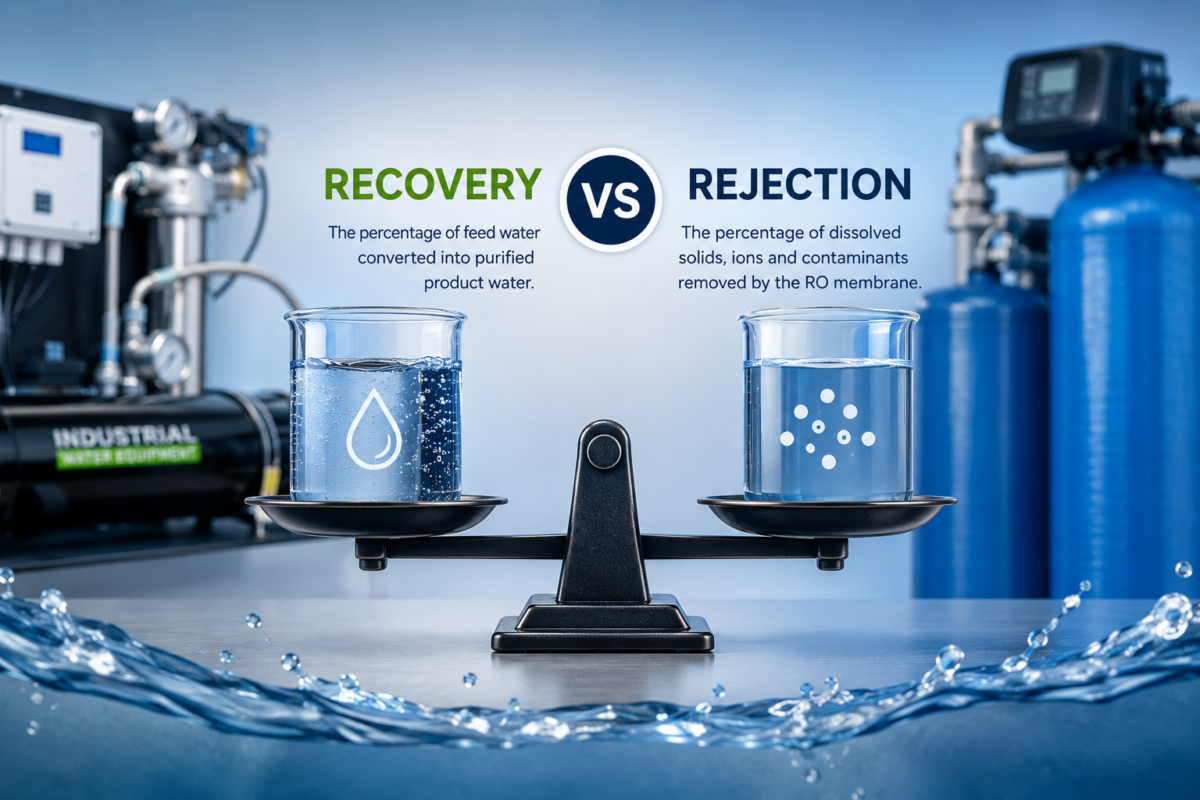
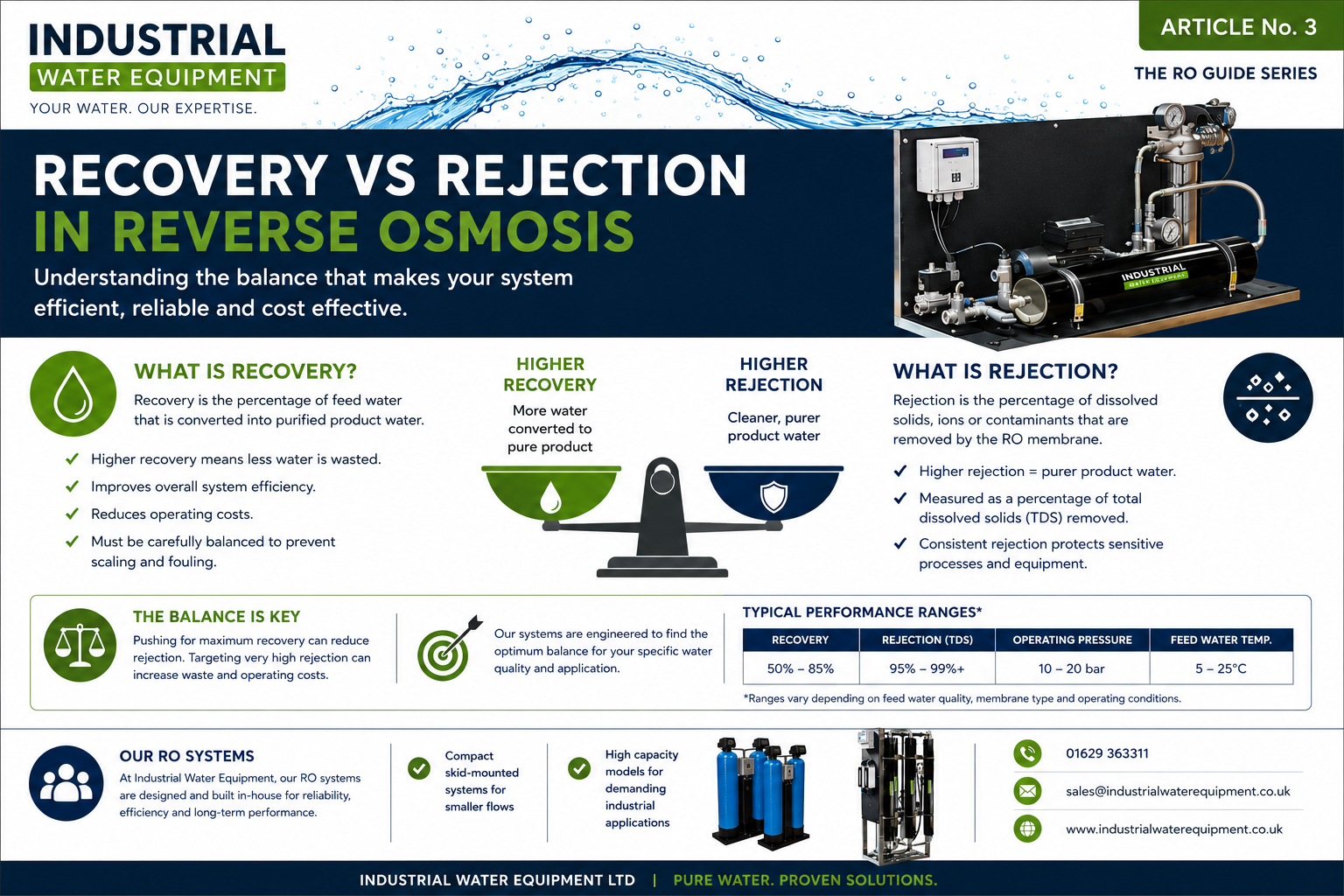
Recovery refers to the percentage of feed water that is converted into purified product water.
For example:
- Feed Water = 1000 litres
- Product Water = 750 litres
- Concentrate = 250 litres
Recovery = 75%
Higher recovery means more of the incoming water is converted into usable purified water, reducing wastewater and improving overall efficiency.
However, recovery cannot simply be increased indefinitely. As recovery rises, dissolved minerals become more concentrated within the membrane system, increasing the risk of scaling and fouling.
A correctly designed RO system balances water savings with long-term membrane performance.
What is Rejection?
Rejection measures how effectively the RO membrane removes dissolved contaminants from the feed water.
These contaminants include:
- Calcium
- Magnesium
- Sodium
- Chloride
- Sulphates
- Nitrates
- Heavy metals
- Many dissolved organic compounds
A membrane with a rejection rate of 99% removes approximately 99% of dissolved solids, producing exceptionally pure water suitable for demanding industrial applications.
Higher rejection generally results in:
- Lower conductivity
- Lower TDS
- Improved product quality
- Greater protection for downstream equipment
Why Recovery and Rejection Must Be Balanced
One of the most common misconceptions is that higher recovery is always better.
In reality, maximising recovery without considering rejection can lead to:
- Membrane scaling
- Fouling
- Reduced membrane life
- Increased cleaning frequency
- Reduced product water quality
Similarly, targeting extremely high rejection without considering operating conditions can increase energy consumption and operating costs.
The most efficient RO systems are designed to achieve the optimum balance for each specific water source and application.
Typical Industrial Performance
Although every application is different, a typical industrial RO system operates within the following ranges
| Parameter | Typical Range |
|---|---|
| Recovery | 50–85% |
| Rejection | 95–99%+ |
| Operating Pressure | 10–20 bar |
| Product Conductivity | Application dependent |
Performance depends on feed water quality, temperature, membrane selection and system design.
How Industrial Water Equipment Optimises RO Performance
At Industrial Water Equipment, every reverse osmosis system is engineered around the customer’s specific water quality and process requirements.
Rather than offering a one-size-fits-all solution, we consider factors including:
- Feed water chemistry
- Required water quality
- Water demand
- Recovery targets
- Running costs
- Future maintenance requirements
This ensures every system delivers dependable performance while keeping operating costs under control.
Need Advice on Your RO System?
Whether you’re specifying a new reverse osmosis plant or looking to improve the performance of an existing installation, our team can help you find the right balance between recovery, rejection and operating efficiency.
Our experienced engineers design and manufacture industrial RO systems for a wide range of industries across the UK.
Contact Us
📞 01629 363311
✉ sales@industrialwaterequipment.co.uk
🌐 www.industrialwaterequipment.co.uk
